It had to happen. I picked 2 esoteric choices for the first Car of the Day entries and so now I have to pick a Ferrari.
Sorry.
I’ve been nuts about Italian cars since I was a kid. Blame my parents. Blame Magnum PI or Miami Vice. Blame Beverley Hills Cop II. Blame Cannonball Run (One and Two, but mainly One).
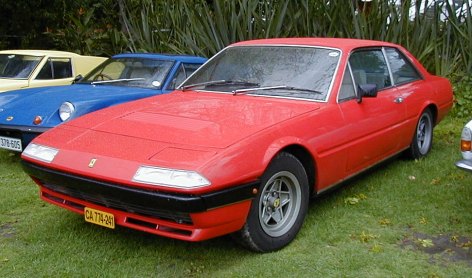
However: in keeping with the spirit of these vehicular outbursts, I’m going to select one of the most unpopular cars to ever leave the Maranello factory gates – the 365 GT4 2+2/400/412 series.
Even at the height of the car boom of the late 1980s, these front-engined four seaters were tricky to shift. And this was at a time that people were paying over list-price for anything with a prancing horse on the bonnet and it was possible to sell a brand new car for a huge profit just by taking delivery of it.
You can trace the disinterest in the series through the history of 2+2s that the company have made (2+2 meaning “2-in-the-front/2-in-the-back”, or “not quite a 4-seater really, unless you’re really short or you don’t have legs”).
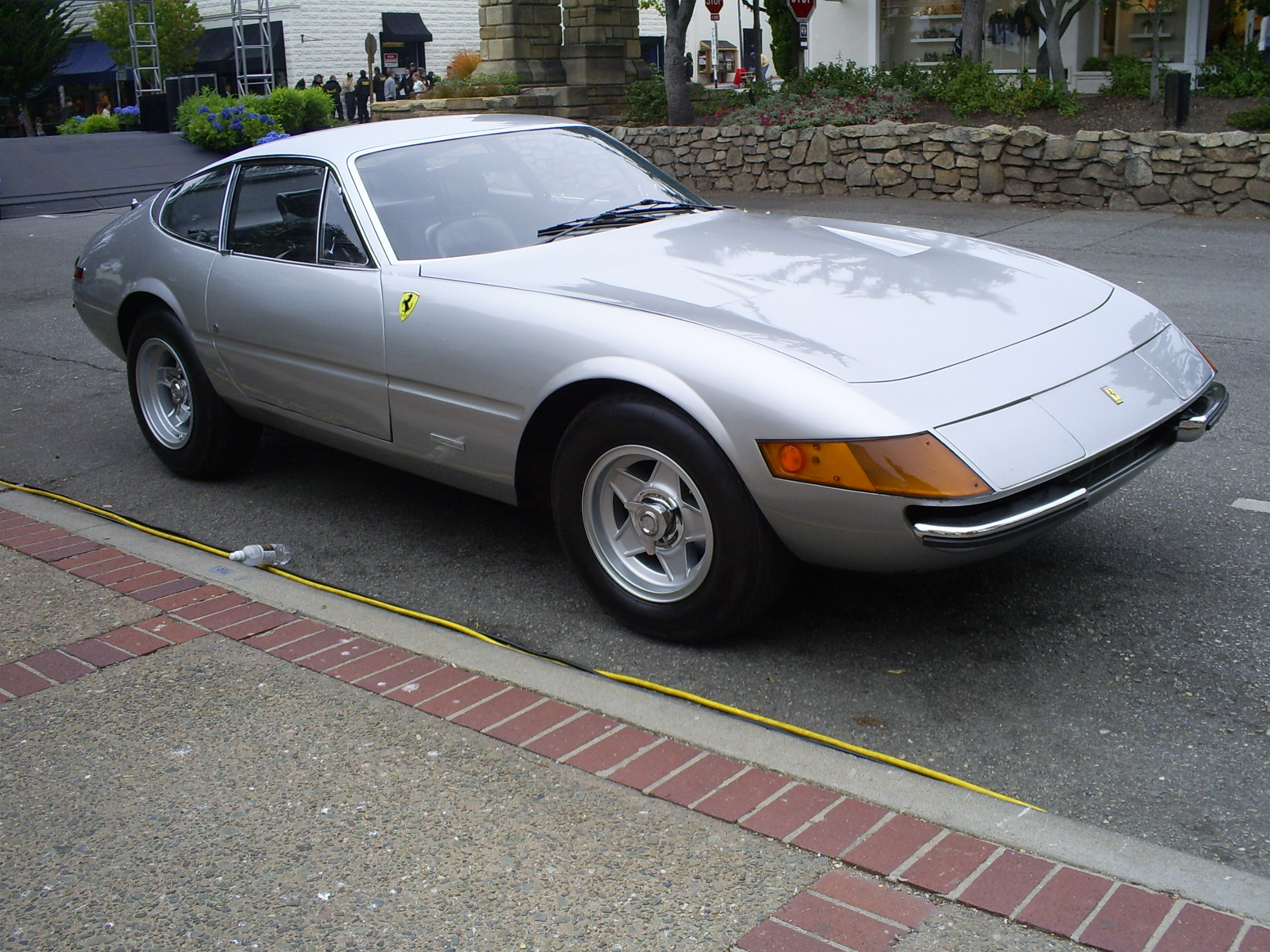
The wonderful 250GTE was the first mass-production car that Ferrari produced. An elegant but muscular saloon powered by the same V12 as the more sporty and desirable models but able to take the kids and the luggage to the summer house (at exceptional speed). It had the poise of a street rod but the simple and beautiful design details of it’s more valuable (now) siblings like the 250 GT SWB. Crucially, it’s a subtle car.
It’s easily in my Top 10 Ferraris, maybe even my Top 5. As someone who can name over a thousand minor variations in the marque and who wrote several thousand words (for no real reason) on the great “0846 debate”, this is high praise indeed. I really think about these things. I really am that much of a loser.
However, take a quick look online and you’ll see the majority of these lovely cars have been scrapped, with the mechanical aspects cruelly stripped out and used to build either replicas of more valuable models like the GTO or kept as spares for the real thing by wealthy vintage car racers. Recently an absolutely perfect condition GTE showed up on EBay minus its engine after it was bought at auction solely for items which were to be used as spares for a more financially valuable car. At least someone has the chance to salvage something from this one, elsewhere GTE body shells lie in coachbuilders’ backyards acting as accidental flowerbeds:

It’s heart breaking.
The 400 series (I’ll call it that for shorthand) has a similar story. Brought out in the early 1970s as a replacement for the 365 “Queen Mary” it roughly echoes the equivalent changes to Ferrari design of the period in that the curves and open lights of the older models were replaced with slightly more angular styling and sleeker, pop-up lights (see the 275 GTB to Daytona, or the Dino to 308GTB later on).
Today, it’s possible to pick one of these up for less than a Nissan Micra but the hideous costs of maintaining a 30-something year old, V12 engined Italian car mean few people are wealthy (or brave) enough to take the risk. Specialist breakers’ yards (such as http://www.eurospares.co.uk/) are full of these things. In fact, take a look at this widely circulated photo of the recovered wreckage from the tragic Lockerbie bombing:

That’s right; in the foreground is the remains of a Ferrari 400.
I can’t remember the last time I saw one of these things on the road, moving.
That is a pity, as that’s where they are in their element. Modern cars are designed with the photographic image in mind. Most people will see their first glimpse of a new supercar in print, not in the flesh. So you end up with cars like the Ferrari F50: it looks like a bazooka battleship on a glossy page but it just sits wrong on the road, ending up looking like the outpourings of a just-pubescent male in the back of his maths book.
The 70s period for design house Pininfarina acts as a textbook example of how to design a car that looks great on the road.

Recently I saw a first series Ferrari Mondial (a car similarly maligned in Ferrari aficionado circles) on the road and it looked fabulous. Squat, hunched forward, clearly defined and unfussy in detail compared to modern Ferraris. The 400 perfectly illustrates this line of thinking, though you can see why it isn’t universally considered a design classic.
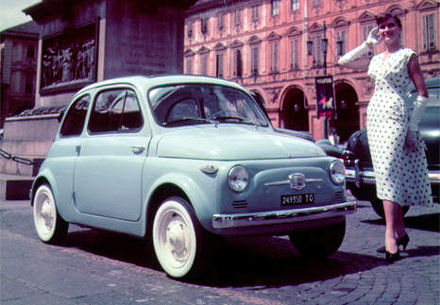
In photos it’s hard to determine its “face”. Its curious bi-level nose is the culprit – making it hard to define the crucial eyes and mouth recognition that makes a car appealing to us weird human types. That face recognition is why we see the Morgan Aeromax as cross-eyed, the Citroen DS as “Shark-like” and the Fiat 500 as unthreatening. The 400 is just confusing – from standing eye-level at least. It looks like it should solely have pop ups like a Bitter Coupe or BMW 8 Series; or a more defined and stepped up nose like the latter Pininfarina concept car the Ferrari Pinin, or other equally luscious Farina creations like the Lancia Gamma Coupe or the Fiat 130 Coupe. The Aston Martin Lagonda suffers from the same styling problem (among many others – though it too looks incredible on the road). Plus, the need for 4 seats makes it all look a little stretched and poorly balanced. In photos it’s only the rear ¾ view that appeals.

Put it on the road next to the cars of the time (or now) though or crouch down and look at one from a seated perspective and it looks fantastic. I remember going to the coast in Norfolk with my parents and seeing a black 400GT heading towards us on the other side of the road with its lights up. It stuck in my mind like a photo. The car’s width and poise make it look perfectly aggressive whilst still being strangely subtle (for an enormous V12 supercar). It is the absolute antithesis of the F50 and I am willing to stake money that it will age significantly better than either the current 599 or its direct descendant the 612 Scaglietti, both of which are too big, too ostentatious and too sloppy looking to really work. The 612 in particular looks like the early stages of an omelette. The angular, sweeping 400 is confident and bold in comparison and represents the perfect gentleman (or woman) express.
It’s also the only Ferrari I have ever been in. My late Granddad called me up to say I should pay him a visit with my Dad when I was about 13 or so. He took me to see a mechanic neighbour of his who had borrowed a late 70s 400GT from his work to offer rides to kids at a garden fete. I think it was registered APG 58T. It was £55,000 back then. You could get one for a tenth of that now. It was in a perfectly 70s metallic silver blue/green with tan leather inside. I went for a ride in it and it felt like it was taking off on the road between Northborough and Peakirk. I remember looking at the speedo and it saying 130 mph. Judging from Ferrari’s optimistic speedos it was probably closer to 100 but that’s still plenty on an A road in a car that weighs the same as a bungalow. It was a carburetted model too so the noise was deafening – even though this was supposed to be a more civilized Ferrari. It left quite a mark on me. The registration doesn’t show on the DVLA database as being taxed anymore. I wonder where the car is - probably languishing in a parts yard somewhere or, worse still, re-born as several hundred Coke cans.
So why is it so unpopular? I’d guess it’s because people who want a Ferrari tend to lust after one for years and it signifies that they have somehow “made it” when they own one. So they inevitably buy a red one and want it to be as striking looking as possible so the neighbours get the message. The 400 just doesn’t fit with that. For one, it looks terrible in red (a lot of Ferraris do, oddly) and despite its gargantuan power train and enormous grunt it’s hardly a sports car. It’s aimed more at the discreet Mafia boss than the freshly-famous pop star or footballer.
Its cheapness tempts owners new to the marque who then find they don’t have the pit of funds required to maintain it as it should be maintained so lots of these cars are in a serious state of disrepair now and with the values so low they’re more liable to be broken for spares than they are restored as working on a V12 Ferrari costs the same amount regardless of whether that car is worth 10 thousand pounds or 10 million. Which is a shame.
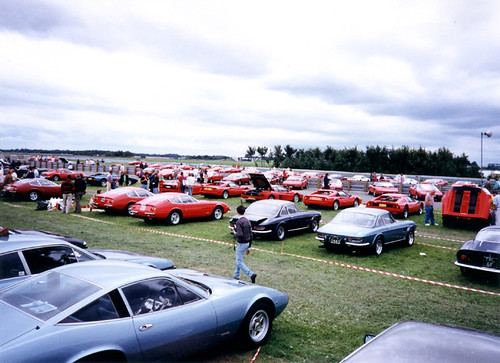
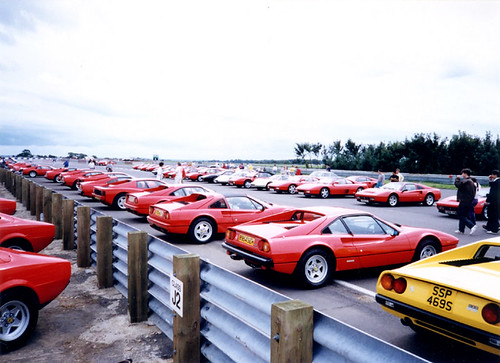
I went to a Ferrari car show recently and in amongst the sea of red wedges - all with their owners in red polo shirts with red golfing umbrellas - was a solitary 412GT in a deep bronze colour. It was driven by an elderly gentleman who rolled up – not in an explosion of exhaust noise and tyre screech but in relative calm – and sat reading the paper in it before donning his panama and leaving as quietly as he had arrived.
That is why the 365GT2+2/400/412 deserves a re-evaluation – it’s a car with real class.

Value now: you can get a good one for £20,000
Pub quiz trivia fact: Jeremy Clarkson might have called it "awful in every way" and relegated it to an entry in the Top Gear Crap Cars book but Daft Punk didn't agree with him and made a black 412GT the star of their film Electroma in 2007:
Links:
Wikipedia
Online Forum
Octane Article
Registry




 Posts